
Can You Handle the Truth?
how to find (and be) a good beta reader


photo: Houcine Ncib on Unsplash
So, you’ve done the damn thing. You’ve written a whole book, something most people will never do. First of all, CONGRATULATIONS! This is big! Huge!
But is it any good?
Enter: beta readers.
Do not, I repeat DO NOT skip this step. Don’t even think about sending your manuscript out to literary agents unless you have done your due diligence with this crucial piece of the puzzle: finding, enlisting, and implementing feedback from good fit beta readers.
What is a beta reader? A beta reader is someone who reads a (ideally pretty polished) full draft of your manuscript before you launch into further revisions, querying agents, and (hopefully! someday!) publishing your masterpiece. Many agented and published authors still swear by using their trusty beta readers (aka “early readers” or “first readers”) for every new book they write. This is a pro move, friends!
Because here’s the thing—you’re way too close to your project to know if it is, indeed, a masterpiece, or if it’s more of a hot mess. In fact, many of us writers see our own work as swinging wildly from one camp to the other depending on the day, or on whomever we happen to be comparing ourselves to at the moment. Fresh eyes on our work is not a luxury; it’s a necessity.
Now that we know what a beta reader is, let’s break down why you need them, how to find them, and how to be a good one for your fellow writer friends.
Why we (all) need beta readers
As I touched on above, we’re simply too biased, too subjectively close to the thing we’ve written and rewritten and obsessively micro-edited countless times to see the forest for the trees.
“The trees” of writing may include: you renaming that one minor character four times, going down that weird subplot rabbit hole inspired by an inside joke you and a friend had in middle school, or that beautifully written description of how grass grows that does nothing to further your story. It’s like that scene in Love Actually when Rowan Atkinson’s character takes seven years to wrap a gift. Sure it’s pretty, but dear god can we get on with it?
“The forest” of writing asks: Does my book make sense? Who cares, and why should they? Are there parts of it that only I care about, that may bore my readers to tears (i.e. darlings I need to kill)? Are my jokes landing? Are there plot holes the size of Chernobyl? Does the story flow? Does each chapter end in a way that makes one want to keep reading? Am I surprising my readers? Making them think? Making them curious?
What a good beta reader does
A good beta reader is familiar with the kind of book you are writing. They understand the basic conventions of the genre and can spot when you’re way off track. They need not be a writer, but they should be an active reader who will do a close read of your work and deliver the cold hard truth of how it’s landing (or isn’t). It is your job to tell them specifically what kind of critique you are and are not looking for. It is their job to provide detailed feedback about what’s working and what’s not on multiple levels, gifting you with priceless honest insight that you can use to better your story.
What a good beta reader does not do
Say, “This is perfect, no notes! NYT list, here we come!”
Be so critical that you are left with no will to keep going and wonder if your manuscript would be better used as kindling to warm your cold cold heart. (Encouraging feedback about what is working is just as important as kindly pointing out what needs improvement. Be nice!)
Give up halfway through your book. When you agree to beta read for someone, you are making a commitment to see it through with thought and care, honoring the hundreds of unpaid hours the writer has poured into their project. Even if their book turns out to be not your cup of tea, keep your word and see it through.
How to find beta readers
Ask! Ask readers in your life, people you’ve taken writing classes with, writers you’ve connected with on Instagram or Substack. If your partner or best friend or mom is among your beta readers, be sure to enlist a few others who aren’t quite as ride-or-die and might have an easier time being brutally honest.
Bianca Marais has a fabulous beta reader match up program that just might be the best $25 you ever spend on your writing.
Offer to read for someone else. Chances are they’ll return the favor when the time comes.
When to use beta readers
Often writers will use more than one round of beta readers throughout the process of writing and revising a project. For the book I’m currently working on, I enlisted four readers to read my second draft. I plan to have a fresh round of 3-5 more readers review my third draft, which I’m working on now. Personally, I like to use a mix of tried-and-true (have read for me before) and new-to-me readers. I typically will not ask the same person to read more than one full draft of the same book. Because that’s a big ask, and I want to stay friends with them. : ) Beta reader burn out is a thing!
Ten key questions to ask your readers
1. Did the novel deliver on its premise/pitch?
2. Is the inciting incident big enough/clear enough/impactful enough?
3. How was the overall pacing? Were there parts that felt too long or meandering, where you felt your interest slipping? Or parts you wished I spent more time developing?
4. Did you connect with the characters? Were they interesting? Vulnerable? Curiosity-inducing? Memorable?
5. What were some things you liked most about the book? Favorite lines/scenes/moments? What were some positive feelings you experienced while reading?
6. What are some things you wanted more of?
7. Were there twists you saw coming, or ones you were totally surprised by?
8. Did you feel that the characters’ lives and storylines intersected in interesting and cohesive ways?
9. Did the level of description (re: setting, what characters are doing, thinking, etc…) feel like too little, too much, or just right?
10. Was the ending satisfying? Any loose ends or plot holes that need tending to?
THANK THEM!!
Being a beta reader is a very generous gift of one’s time and mental energy. I would estimate that it typically takes me anywhere between 10 and 20 hours to thoughtfully read and critique a full manuscript as a beta reader. When someone agrees to read for me, I always make it abundantly clear how deeply grateful I am for their time and thoughts. At the very least, communicate your sincere gratitude via an email. I have also sent snail-mail thank-you cards and small gifts as tokens of my appreciation.
I also think it’s important when you are *asked* to be a beta reader, to thank the writer for trusting you with their work. Asking someone to do a close, critical read of your book-length document is a big ask, yes. But it is still one that takes vulnerability and courage. I am always honored when someone asks for my eyes on their work and trusts that I will follow through with my commitment and provide them with feedback that is incisive, actionable, and encouraging. I never take my role on either side of the beta reader relationship lightly, and you shouldn’t either. These are all deposits into the ‘literary citizenship’ bank, friends. Not to mention, reading critically for someone else will undoubtedly make you a better, sharper writer, too. It all counts.
Beta vs Alpha readers:
You may also hear the word “alpha reader” thrown around. The difference between alpha and beta readers depends either on the quality or quantity of the feedback, depending on who you ask. I think of alpha readers as those who read smaller chunks of my work as I’m drafting. For example, within my critique group, we exchange around 3,000-5,000 words at a time. Other definitions I’ve seen consider alpha critique to simply be a broader level of feedback, and beta critique as more of a thorough deep dive. As with most things in writing and publishing, ask ten people and you might get ten different answers. : )
WHAT I’M READING:
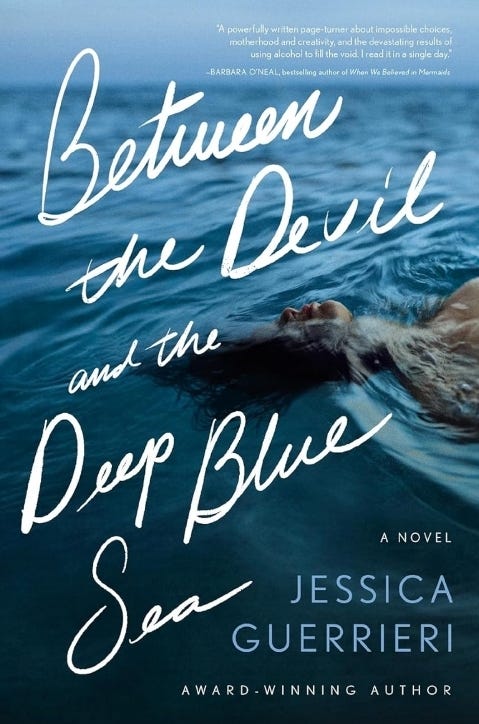
I just finished reading an ARC (advance reading copy) of my friend Jessica Guerrieri’s debut novel, Between the Devil and the Deep Blue Sea. I was blown away by its lyrical prose and blunt exploration of addiction and the often-overlooked costs of motherhood. You can pre-order Jess’s book here. Bravo, Jess! I have no doubt this novel will resonate deeply with so many people. If you’re in a book club, scoop this one up. It is ripe for discussion.
WHAT I’M WATCHING: I’ve been gobbling up season 3 of White Lotus and the first season of The Pitt.
WRITING RETREATS & CONFERENCES:
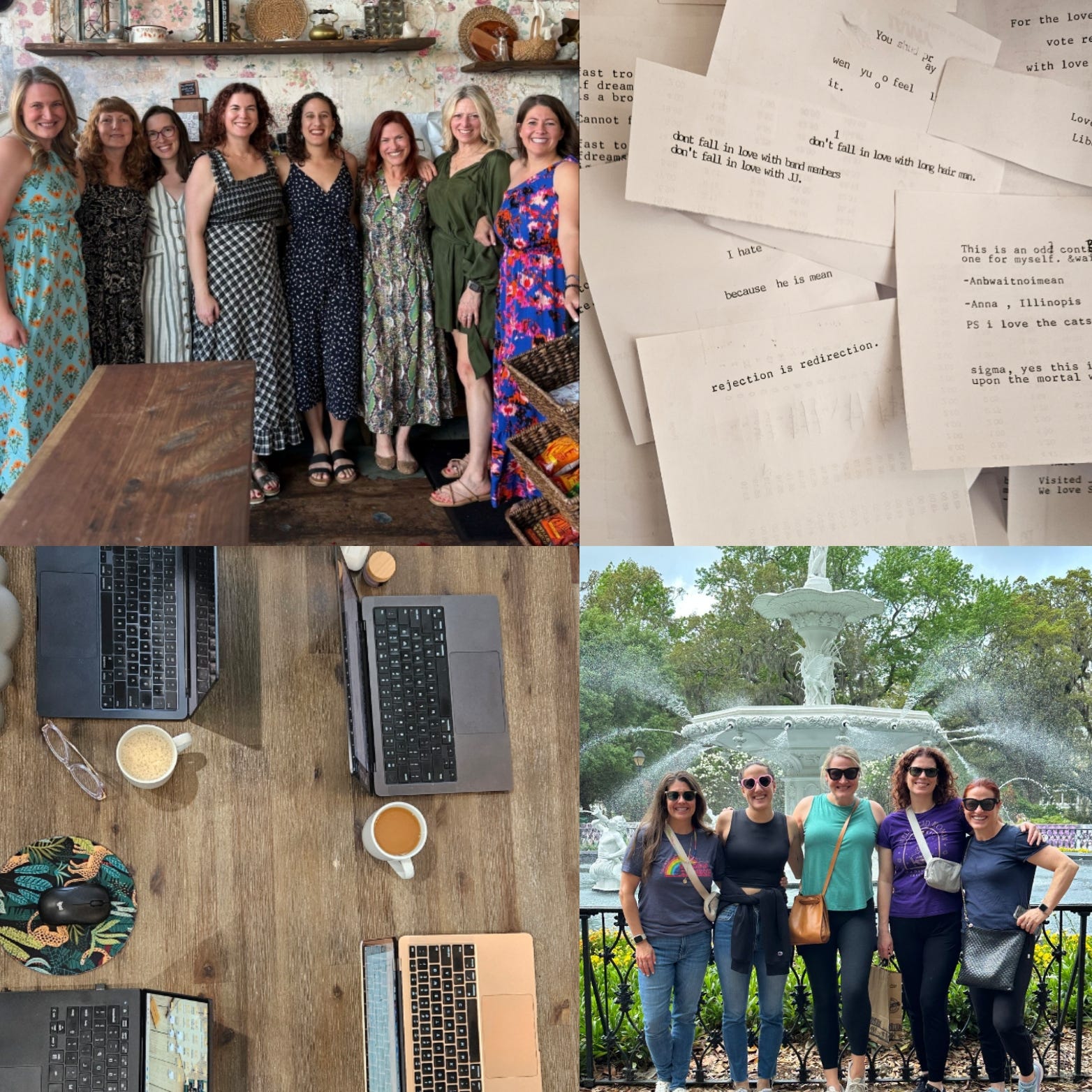
I just returned from a wonderful week in charming Savannah, Georgia, where I participated in a DIY-style writing retreat with seven other women. We wrote, read our work aloud, tore up pieces of paper scribbled with our fears and manifested our successes. We laughed, cooked, hot tubbed, beach walked and ate. 10/10 recommend gathering a group of writing friends and blocking out the time to write together and lift each other up in all the ways. It is a magical time of connection and rejuvenation, well-worth the planning and preparation.
WHERE I’M HEADED NEXT:
I recently signed up to attend DFWCon (Dallas Fort Worth Writers Conference) in October. I’m so excited! Featuring keynote speaker Carly Watters, it’s a jam-packed weekend full of workshops, presentations, live agent pitches, networking opportunities, and more. I wrote about it and interviewed two-time DFWCon attendee, Cortney Casey, here.
Thanks for reading, and wishing you all a wonderful, productive week ahead!
PS- If you are a querying or soon-to-be-querying writer who could use some fresh eyes on your work, I’d love to help! My March was full of time spent reviewing query letters, opening pages, and more for several new clients. It has been a joy to read their work! I’m now booking for April and beyond, and would love to help you on your query journey. Visit my website for more info.
PPS- Earlier this year I began leading free writing accountability groups 2-3 times a week on Zoom, and they have been so fun and rewarding! Days and times vary; visit my website for more info and/or contact me to be added to my email list.
Absolutely needed this post in my life right now - and going to check out DFWCon asap. Thanks for these incredible tips!
Great tips!